
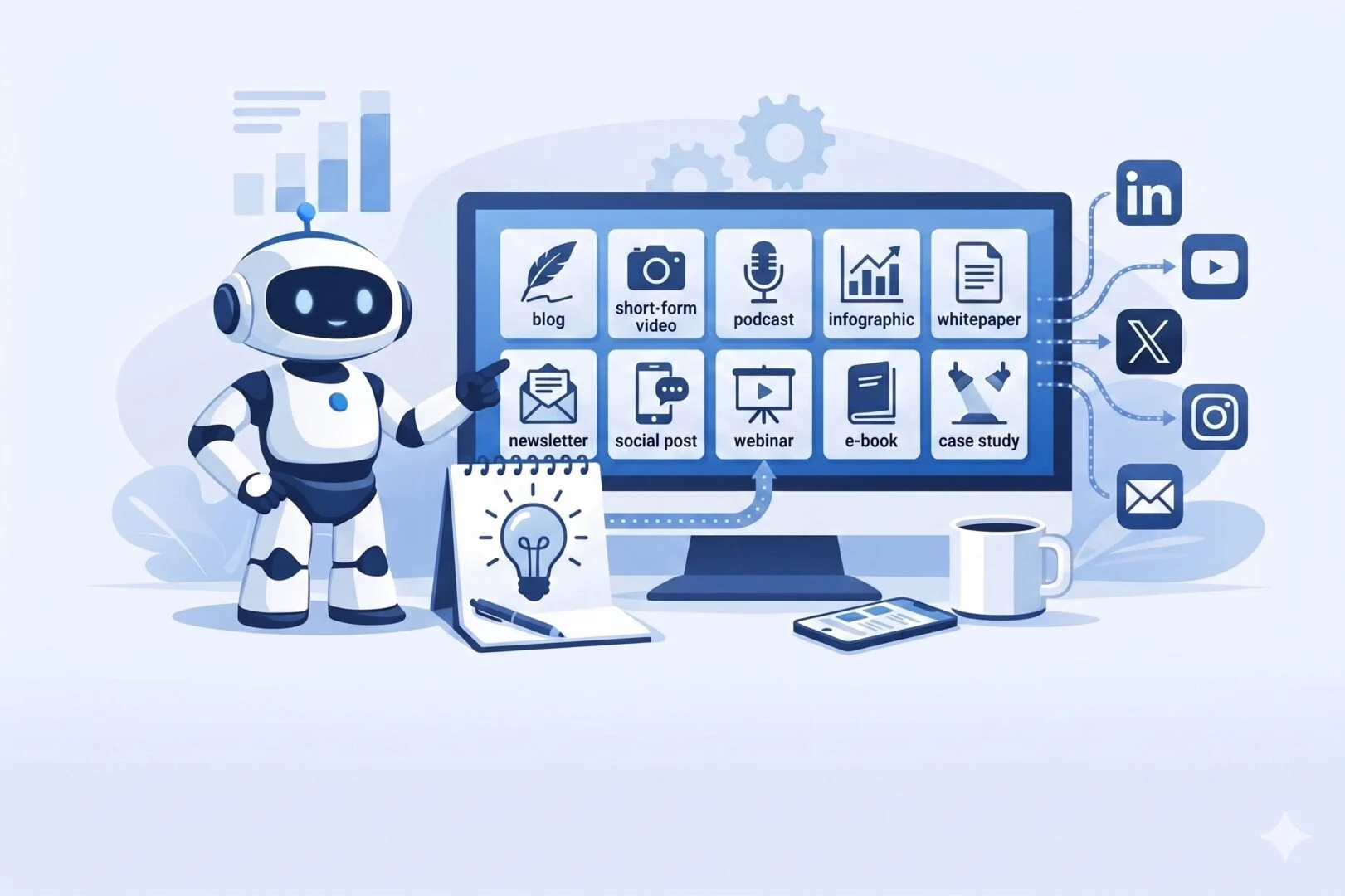
In 2026, publishing a blog post is half a content strategy. AI engines pull answers from your blog, your YouTube transcripts, your Reddit comments, your LinkedIn posts, and your podcast appearances — all five surfaces at the same time. Your buyer might ask ChatGPT a question that pulls from your YouTube video, then ask Perplexity a follow-up that pulls from a Reddit comment you made six months ago, then verify what they found by checking your blog. The brands that win are present everywhere the AI engines are looking. Most B2B owners have time to produce content for one or two of those surfaces. They need to be on five. That’s the gap Biostack closes. The Refinery — our content pipeline — turns one 30-minute founder interview per month into a full multi-format content library: blog posts, YouTube content, LinkedIn carousels, podcast episodes, short-form clips, and Reddit-ready answer material. One main idea, ten output pieces, distributed across five platforms. The math that used to require a five-person marketing team now runs on one founder interview a month and our production engine — extended by 12 selectively-adopted AI tools (HeyGen Avatar V, Sync.so, ElevenLabs Professional Voice Cloning, NotebookLM, Adobe Enhance Speech, Cuebric, Runway Gen-4, and others — full stack documented here).
The Refinery is anchored on six specific rules from the Storimatic 92 Rules of Brand Marketing in the AI Era: Rule #11 (the 3 Jobs of Content — Capture, Convert, Retain), Rule #38 (the 7 IP Categories — what to remix vs what to protect), Rule #49 (the AI-Allowed Matrix — which production tasks AI can touch vs which require the founder), Rule #51 (the Avatar Rule — when AI-generated humans help vs hurt trust), Rule #52 (the Subject Line Split — how to test what gets opened), and Rule #53 (the Trade-Vocabulary Moat — why operational language can’t be cloned). The rules govern not just what the Refinery produces but which AI tools we use to produce it and which production tasks we refuse to automate. Both decisions live downstream of these six rules.
1. Why Publishing One Blog Stopped Being a Strategy in 2026
For most of the last decade, the B2B content playbook was simple: write blog posts, rank them on Google, watch traffic become leads. Some companies added LinkedIn. A few added podcasts. The smart ones started YouTube. But blog-first was the default.
That playbook collapsed faster than most operators noticed.
The reason isn’t that blogs stopped working. They didn’t. The reason is that the discovery surface multiplied, and brands that only show up on one or two surfaces become invisible to buyers who are searching across five.
A B2B buyer in 2026 doesn’t research a vendor by typing keywords into Google and reading the first result. They:
- Ask ChatGPT “who’s the best [your category] in Calgary for [their specific use case]?” — and get back a synthesized answer pulling from multiple sources
- Cross-check on Perplexity for the technical specifics (Perplexity tends to cite primary sources more aggressively, which technical buyers trust)
- Watch a YouTube video on the topic — sometimes a long-form, sometimes a 60-second Short
- Check LinkedIn to see if the founder of that company posts and what they sound like
- Scroll Reddit to find unbiased opinions from people who’ve actually used the vendor
- Maybe finally land on your website to confirm what they’ve already decided
Five-plus platforms touched. Multiple AI engines synthesizing across them. Your blog is one of the six stops — not the starting point.
The brands that are findable across all of those platforms appear in the AI engine answers. The brands that aren’t, don’t. There’s no longer a “Google #1” prize that protects you from this.
Neil Patel’s NP Digital recently quantified the shift: across 4,308 AI prompts tested over 500 keywords, 90% of pages ChatGPT cites rank #21 or lower on Google, and 75% of AI citations come from sources that don’t appear in Google’s top results at all — Reddit threads, YouTube transcripts, niche publications, podcast appearances, third-party reviews. (Full breakdown of Patel’s research and what to do about it →)
The implication: if you only publish blog content, you’re optimizing for a smaller and smaller slice of the discovery surface every month. Even a perfectly-ranked Google page can’t move the needle if AI engines are pulling answers from four other surfaces where you don’t exist.
This is the problem Biostack was built to solve.
2. The 5 Platforms Your B2B Buyers Actually Search (and the 1-2 Most Brands Are Stuck On)
Before getting to the solution, here’s the audit most B2B owners haven’t done.
In a category where your brand needs to be findable, these are the surfaces that matter in 2026:
| Surface | What it does | What most B2B brands have here |
|---|---|---|
| Your blog (on your website) | The canonical knowledge base; the foundation AI engines cite when they need to verify a claim | Some posts, often years old, rarely refreshed |
| YouTube (long-form + Shorts) | The single largest AI-citation correlation surface — YouTube mentions correlate ~3x with AI citation vs backlinks (Ahrefs Dec 2025) | A handful of older videos, often a dead channel |
| LinkedIn (personal profile + native video) | The B2B trust signal — personal profiles outperform company pages 5–8x, and 8 in 10 B2B teams now name LinkedIn as their primary video channel (PPC Land / Wistia 2026) | Sporadic posts from the company page, almost nothing from the founder |
| Reddit (genuine answers in relevant subreddits) | The #2 source AI models cite (behind Wikipedia, ahead of every traditional SEO signal). Pure citation surface — has to be authentic comments, not posts | Almost nothing — most B2B brands ignore Reddit completely |
| Podcast feed + AI-narrated audio | Long-form context for AI engines + accessibility for buyers who consume by ear; transcripts become first-class citation surfaces | Either zero or one early-stage attempt that died |
The pattern is consistent across the 47-engagement audit we’ve run inside the Storimatic Studio client roster (and now the broader Biostack client base): most B2B operators have meaningful presence on 1–2 of these 5 surfaces. They need to be on all 5.
The buyer doesn’t care which surface they encounter you on first. They care that they encounter you, then verify you across the others, then trust the picture that forms. If two of the five surfaces show nothing — “this vendor has no YouTube content, no Reddit presence, no podcast — are they actually a real player?” — the trust collapses.
Per Storimatic Rule #11 (the 3 Jobs of Content): every piece of content does one of three jobs — Capture (top of funnel — discovery, AI citation, cold reach), Convert (middle — proof, demo, comparison, trust), or Retain (bottom + post-sale — onboarding, community, referral). The 5-platform audit above maps cleanly: YouTube long-form + blog do Capture; LinkedIn personal + podcast do Convert; Reddit + email newsletter + on-platform community do Retain. A brand that’s only on the Capture surfaces (most B2B brands today) generates AI mentions that never convert. A brand that’s only on Convert surfaces (the old-school sales-team-only operator) starves the top of funnel. The Refinery’s job is to make sure all three content jobs get done from a single founder input, not just whichever one the founder finds most comfortable.
3. The Operator’s Bind: The Demand Is Real, the Time Isn’t
[PLACEHOLDER — Jared, drop in one specific friction moment from a real client conversation. The pattern you’ve seen 20 times: “We had the blog handled but couldn’t keep up with video” / “We had the YouTube channel running but no LinkedIn presence” / “We tried to add podcast but it died after 4 episodes.” One specific anonymized story makes this section 2x stronger.]
Talk to any B2B operator about content and the same picture appears:
- They know they should have a content engine
- They know it should produce across multiple formats
- They have one person on the marketing team (often a junior content writer)
- That person is already maxed out producing blog posts
- The owner is on the road / on site / in meetings, with no bandwidth to film YouTube, post on LinkedIn three times a week, draft Reddit answers, record a podcast, and refresh the blog quarterly
The math doesn’t work. The demand is multi-format. The supply is one writer.
This is the operator’s bind. Most brands respond to it in one of three predictable ways:
Option 1 — Try to do it all and burn out. The founder commits to a daily LinkedIn post + weekly YouTube + monthly podcast + quarterly blog refresh. It works for 6 weeks. Then a big project hits, content drops, and the engine dies. The brand is in worse shape than if it had never started, because now there’s visible abandonment instead of invisible absence.
Option 2 — Hire a marketing team of 4-6 people. A writer, a video producer, a social media manager, an editor, a strategist. The total cost runs $400K-$800K annually. Coordination overhead burns 30% of the team’s capacity. Most B2B operators in the $5-50M revenue range can’t justify the spend and the management cost.
Option 3 — Do one channel only. Pick the most-loved channel (usually blog, sometimes LinkedIn) and ignore the rest. The brand survives but the multi-platform discovery gap above keeps widening.
None of those options work in 2026. The buyer is on five platforms. The founder has time for one interview a month. The marketing team is one person or zero.
That’s the gap we built Biostack to close.
4. Why We Built Biostack — The “One Idea, Many Forms” Premise
I run three businesses: Biostack (the AI visibility agency you’re reading from), Storimatic Studio (Calgary video production for construction and trades), and Omega Group (Omega Ready Mix, Omega 2000 Cribbing, Omega Precast — all Edmonton concrete-business operating companies that I own).
The Omega Group is the reason Biostack exists.
Running Omega put me on the wrong side of the operator’s bind I described above. I needed content to be findable for Omega Ready Mix’s new buyers. I had no time to produce blog posts AND YouTube videos AND LinkedIn presence AND podcast episodes AND keep tabs on Reddit conversations about Calgary/Edmonton concrete supply. Storimatic was already producing video content for me, but the video wasn’t being remixed into the other formats AI engines also crawl.
So we built the production system that solved my own problem. Then we tested it across the three Omega operating companies. Then we externalized it as Biostack so other B2B operators could buy what had been our internal answer.
The core premise: one main idea — extracted from the founder’s expertise — should produce content across every format their buyers encounter.
Not “one blog post turned into 10 social media excerpts.” That’s lazy repurposing.
What we mean: one idea — say, “Why a volumetric mixer beats a barrel mixer for a small pour” — becomes:
- A 2,500-word blog post with FAQ schema and full GEO/AEO optimization
- A YouTube long-form video (the founder explaining it on camera — optionally enhanced with Cuebric storyboarding, DaVinci Resolve Neural Engine color, and Adobe Enhance Speech audio cleanup)
- 4-6 YouTube Shorts (cut from the long-form, vertical 9:16)
- A podcast episode (audio-only version — for non-camera weeks we use NotebookLM Audio Overview or ElevenLabs Professional Voice Cloning to produce a founder-voiced narration without booking studio time)
- 4-8 LinkedIn posts (carousel + native video + text-with-image)
- A Reddit-ready answer template (so the founder can drop a genuine comment in r/Construction or r/AskACanadian without restarting the brain on the topic)
- 1-2 Instagram Reels / TikTok cuts (vertical short-form, repurposed from YouTube Shorts)
- A monthly email newsletter section (drawing from the same source material)
That’s one idea, ten-plus pieces of content, five-plus platforms — from one 30-minute interview with the founder. The math finally works.
This is The Refinery.
Rule #38 (the 7 IP Categories) governs what gets remixed across formats and what stays single-use. The 7 categories: Frameworks (named systems like the 5P Formula), Stories (named case-study moments), Data (your operational numbers), Tools (assets you’ve built — checklists, templates), Lessons (the why-it-failed learnings), Vocabulary (terms you coined or own in your category), and Predictions (positions on where the industry is going). The Refinery treats Frameworks, Stories, and Data as high-remix material — the same one is re-cut into multiple formats. Tools, Lessons, and Vocabulary get used once per month max (overuse devalues them). Predictions get used once per quarter and only when the founder is willing to publicly own the position. This is why a single founder interview can produce 19-30 distinct content pieces without feeling repetitive — the 7-category map prevents the same Lesson from showing up four times.
5. The Refinery — How One 30-Minute Interview Becomes 10+ Pieces of Content
The Refinery is a 4-step production pipeline. Each step is built to solve a specific problem in the operator’s bind.
Step 1 — The 30-Minute Email Interview
The founder answers structured questions about a topic they already know cold — usually drawn from real buyer questions, real sales-call objections, or recent operational moments. No camera. No studio. No production tech. Sometimes the interview is text-based; sometimes it’s a 30-minute voice memo or a casual recorded call. The output is raw expertise — the kind of answer the founder would give a friend over coffee, not the kind they’d give in a polished marketing video.
This is the only step that requires the founder’s time. The total monthly time cost: 30 minutes.
The E/I Question Tagging Discipline (borrowed from the Art of Documentary interview master class — canonical reference for our interview craft, documented in storimatic-corp-01)
The questions we send the founder are pre-tagged E (Emotion) or I (Information). We deliberately weight toward E. “What was going through your head when the contract closed?” (E) gets a richer response than “When did the contract close?” (I). The E answers become the hooks; the I answers become the supporting structure.
The Optional On-Camera Upgrade Path
For founders who want to add the visual layer, the 30-minute interview can be captured on camera using the Storimatic Executive Interview Method (the same 3-camera, 35mm-default, 3:1-depth-ratio, shadow-side-placement, circle-back-at-the-end discipline documented in storimatic-corp-01). The founder time stays at the same 30 minutes — the production layer happens around them. The on-camera version unlocks:
- Native YouTube long-form video (8-15 min, founder framed on 35mm)
- 6-12 vertical 9:16 Shorts cut from the long-form
- LinkedIn native video (4:5 or 1:1 cut for the personal-profile feed)
- A higher-trust podcast surface (founder voice + on-camera reference frames for the YouTube Podcast format)
- Provenance-signed footage where the camera supports C2PA (per Rules #91-92)
The non-camera version still produces all the text + audio outputs. The on-camera version multiplies the format library by ~50% and is the recommended upgrade once the founder is ready for the visual layer. Either way, the irreducible founder input stays at 30 minutes.
Step 2 — AI + Human Co-Creation
The raw interview feeds an AI-assisted drafting process. AI handles the heavy lifting on first drafts, format expansion, and structural extraction. Human editors then refine for voice, accuracy, and copywriting discipline (Patel/Siu standards: front-loaded numbers, named entities, no slop, no generic insights).
This step is what makes the system different from “AI does the content.” Pure-AI content fails the AI-extractability test paradoxically — it’s smooth, generic, and unmemorable, which means AI engines synthesizing answers downstream don’t cite it. The founder’s actual voice and specific knowledge survive intact. The AI does the volume work. Humans guard the signal.
Rule #49 (the AI-Allowed Matrix) is the decision framework that governs which tasks AI touches. The matrix has three columns: Green (AI does the work end-to-end, human reviews), Yellow (AI drafts, human meaningfully rewrites), Red (founder/operator must do — no AI shortcut acceptable). In the Refinery:
- Green: transcription (Descript), audio cleanup (Adobe Enhance Speech), color grading (DaVinci Resolve Neural Engine), schema markup generation, captions/subtitles (Adobe Premiere Speech-to-Text), keyword research, distribution scheduling.
- Yellow: first-draft long-form blog, first-draft LinkedIn posts, first-draft podcast script — all human-rewritten before publish; B-roll generation (Runway Gen-4, Veo 3.1, Kling 3.0) for non-jobsite visuals where stock footage would otherwise be used.
- Red: the 30-minute founder interview itself, voice authenticity decisions, anti-ICP positions, named-customer stories, anything involving real client identification, all final-publish approval, every Reddit comment.
The Yellow column is where most “AI agencies” fail — they let AI ship without the human rewrite, and the output crashes into Rule #50 (the Slop Penalty). The Red column is where most B2B operators fail — they try to delegate what only they can do.
Step 3 — Multi-Format Production
The refined material gets reshaped into the format library:
- Blog post (long-form, schema-rich, GEO/AEO optimized)
- FAQ block (extractable Q-and-A, FAQPage schema)
- YouTube long-form (founder on camera, ideally captured in the same session as the interview — or, when the founder can’t sit on camera, a clean ElevenLabs voice-cloned narration paired with B-roll the founder approves frame-by-frame)
- YouTube Shorts (vertical 9:16 cuts from the long-form)
- LinkedIn native posts (carousel, native video, text + image)
- Podcast episode (AI-narrated via NotebookLM or ElevenLabs, or founder-recorded audio)
- Reddit answer seeds (raw material for genuine comments — never auto-posted, always operator-reviewed)
- Short-form social (Instagram Reels, TikTok — same vertical cuts as YouTube Shorts)
- Email newsletter section
The AI tech we’ll touch — and what we won’t, ever. Storimatic and Biostack actively use 12 AI tools across the production pipeline: ChatGPT/Claude (research), Cuebric (storyboarding), DaVinci Resolve Neural Engine (color/upscale), Adobe Enhance Speech (audio cleanup), Descript (transcript-driven editing), Sync.so or HeyGen Avatar V (lip-sync for short translation/localization passes only), ElevenLabs (founder voice clones used only with founder permission and disclosure), AI subject-line testing tools (Rule #52), Adobe Premiere Speech-to-Text (captions), Runway Gen-4 / Veo 3.1 / Kling 3.0 (B-roll where stock footage would otherwise be used — never to fabricate a jobsite or client moment), HeyGen Avatar V / Tavus (founder-cleared avatar deployment for recurring formats like training videos), and NotebookLM (AI-narrated podcast).
4 AI use-cases we refuse: (1) AI-fabricated client logos or testimonials, (2) AI-generated jobsite footage or events that didn’t happen, (3) deepfake humans speaking for the founder without their consent and visible disclosure, (4) fully synthetic Reddit/LinkedIn posts. The full inventory + the 5-question framework we use before adopting any new AI tool is documented in the AI Production Stack for 2026 post.
Rule #51 (the Avatar Rule) governs when synthetic humans help vs hurt. AI-generated avatars (HeyGen Avatar V, Tavus, Synthesia) are net-positive in three narrow use cases: (a) the founder approves an avatar of themselves for repeated training/onboarding video formats where filming the founder 40 times would be uneconomic; (b) translation/localization of an already-shot interview into a second language; (c) FAQ video answers where the same founder voice is needed across 50 short questions. Avatars are net-negative when used as the primary face of a brand the founder isn’t fronting — buyers consistently detect that the brand-person is synthetic, and trust collapses (with secondary Slop Penalty effects on AI citation). The Refinery uses avatars sparingly and always with founder consent and a “this video uses an AI avatar of [Founder Name], approved by them” disclosure when material to the trust call.
The format library is built once and distributed across platforms over the following 4 weeks. The same monthly interview feeds the content engine for a full distribution cycle.
Step 4 — Optimize and Distribute
Schema markup applied at the page level (Article, FAQPage, HowTo, DefinedTerm, Person, Organization, Place). Keywords mapped to buyer-intent queries. Content distributed natively to each platform — not cross-posted with link drops (which the platforms penalize). Each platform gets the version of the content the platform’s algorithm rewards.
Monthly report tracks: organic traffic lift, AI citation share by platform (ChatGPT / Perplexity / Gemini / Claude), inbound DM volume, and the metrics that matter to the client’s actual revenue.
6. The 1-to-10 Math, Worked Out
[PLACEHOLDER — Jared, pick ONE recent Refinery month with an Omega client and trace the actual output. Example structure: “March 2026 interview with Brian on shotcrete applications. Output: 1 × 2,800-word blog post on biostack.ca, 1 × 12-minute YouTube long-form, 6 × YouTube Shorts (PEX, water-softener, hose-drag, etc.), 1 × 18-minute podcast episode, 5 × LinkedIn native posts on Brian’s personal profile, 3 × Reddit answer seeds (used over the following month), 4 × Instagram Reels, 1 × email newsletter section. Total: 22 pieces of content from one 30-minute interview.” Without your specific numbers I’m leaving this slot for you to fill — but here’s the structural template the rest of the post will hang on.]
A representative month inside the Refinery system, for a B2B operator running our Foundation or Growth tier:
| Input | One 30-minute founder interview |
|---|---|
| Blog content | 1 × 2,500-word pillar post with FAQ schema |
| YouTube | 1 × long-form (8-15 min) + 6 × Shorts (under 60s, vertical) |
| 4-8 × native posts (carousel + native video + text + image) | |
| Podcast | 1 × 12-20 minute episode (AI-narrated or founder-recorded) |
| 2-4 × answer seeds (used by the founder in genuine comments over the month) | |
| Instagram/TikTok | 4-6 × Reels (vertical short-form repurposed) |
| 1 × newsletter section | |
| Total | 19-30 pieces of distinct content per single interview |
That’s the 1-to-10+ math working in practice. The unit of input is 30 minutes a month from the founder. Everything else is the production engine.
7. Why This Requires AI + Human, Not Just AI
The temptation in 2026 is to think you can replace the production engine with pure AI. Generate the blog, generate the LinkedIn posts, generate the podcast script — done. Free.
We tried this. Inside the Omega Group, before we built the human-in-the-loop layer. It failed in a specific, instructive way.
Pure-AI content fails the extractability test that the same AI engines you’re trying to be cited by are running on the content. The smoothness becomes a tell. The generic phrasing becomes a tell. The lack of specific operational expertise — “we use a volumetric mixer because barrel mixers waste 8% when the pour is under 4 cubic metres” — becomes a tell. The AI engines downstream are looking for real expertise from real operators, not synthetic content that sounds plausible. They don’t cite the synthetic stuff because synthetic stuff doesn’t earn trust from third-party validators (Reddit users, journalists, peer operators).
The founder’s expertise is the moat. The founder’s time is the constraint. The AI is the production multiplier. The human editor is the quality guardian.
That’s the operating model the Refinery encodes:
- 30 minutes/month of the founder’s expertise = the irreplaceable input
- AI co-creation = the volume multiplier
- Human editors = the signal guardian and voice keeper
- Schema and distribution layer = what makes the output findable
Remove any layer and the system collapses. Pure AI = generic, uncitable. Pure human = won’t scale across formats. No AI = the founder has to produce everything personally. No human = the AI output gets ignored by the downstream AI engines.
The combination is the moat.
8. What You Can’t Outsource (And What You Can)
The honest split that helps B2B operators decide whether the Refinery model fits them:
What you can’t outsource (~30 minutes a month):
- The expertise. Nobody can fake what you actually know about your business. Generic content can’t replace operational specificity.
- The voice. Your customers — and the AI engines synthesizing your content — can tell the difference between you talking and an outsourced writer’s interpretation of what you might say.
- The strategic call on what topic to address. Which buyer question this month? Which operational moment? Which industry shift to respond to? That’s a founder decision.
What you can outsource (the rest):
- Writing the long-form blog from your raw expertise input
- Cutting the long-form YouTube into Shorts
- Repurposing into LinkedIn carousels and native video
- Producing the podcast audio (AI-narrated or edited from founder recording)
- Drafting the Reddit answer seeds (you review and post yourself — Biostack never posts on your behalf, that’s a line we don’t cross)
- Building the FAQ schema and other structured-data layer
- Cross-platform distribution scheduling
- Monthly reporting and optimization
- Email subject-line A/B testing (Rule #52 — see below)
The first three are 30 minutes a month. The last nine are what Biostack absorbs.
Rule #52 (the Subject Line Split) is the smallest, highest-ROI test we run. Every monthly newsletter section gets at least 2 subject-line variants tested against the same audience segment (50/50 split, statistical-significance threshold at 200+ opens per arm). The winning variant becomes the template structure for the following month. Open rates double or triple within 6 months without changing the underlying content — because the Subject Line Split surfaces the language pattern the founder’s audience actually responds to. AI tools (ChatGPT, Claude) generate 8-12 subject-line variants per send; the founder picks 2 to test; humans never write subject lines from scratch anymore. This is a pure Yellow-column task on the Rule #49 AI-Allowed Matrix.
Rule #53 (the Trade-Vocabulary Moat) is why the Refinery refuses to homogenize voice. Every B2B vertical has its own operational vocabulary: in concrete, suspended slab pour, volumetric mixer, slump test, return concrete; in HVAC, MERV rating, static pressure, return air drop; in commercial roofing, TPO, EPDM, cap sheet flashing. AI engines have learned to use these trade-vocabulary signals as quality markers — content with the right operational terms gets cited; content stripped to generic “concrete service” or “HVAC company” doesn’t. The Refinery actively preserves and amplifies trade vocabulary from the founder interview. We don’t let copy editors “clean it up” or “make it accessible.” The vocabulary is the moat. AI engines retrieving content for a specific trade query (e.g., “who supplies volumetric mixer concrete in Calgary for sub-4-cubic-metre suspended slabs?”) cite the brand whose content uses the vocabulary buyers actually search with. Generic content doesn’t get cited because generic content doesn’t answer specific questions.
9. The Verified Results (Omega Group)
The Refinery model was built and refined inside the Omega Group of companies in 2024-2025 before being externalized as a service. The verified results across three operating companies in 12-18 months:
Omega Ready Mix — +247% organic traffic in 8 months
Industry: Concrete supply (volumetric mixer + ready-mix delivery) What the Refinery delivered: Monthly founder interviews extracted Brian’s operational expertise on volumetric mixers, pour scheduling, regional supply dynamics, and customer education. Multi-format output across blog, YouTube, LinkedIn (Brian’s personal profile), and podcast surfaces. Result: +247% organic traffic in 8 months. Same period: significant lift in Perplexity and ChatGPT citation share for Alberta concrete supply queries.
Omega Precast — Top 3 Perplexity AI citations in Alberta
Industry: Precast concrete manufacturing What the Refinery delivered: Heavy emphasis on technical-buyer surfaces (Perplexity dominates technical research) with structured product specification pages, third-party validation through industry publication mentions, and schema-rich product pages. Result: Within a single quarter, Top 3 Perplexity AI citations for relevant Alberta precast queries — across multiple buyer-intent prompts.
Omega 2000 Cribbing — −62% manual admin time per week
Industry: Cribbing services What the Refinery delivered: Content layer plus an AI automation pillar that took manual admin processes (lead intake, quote generation, customer follow-up sequencing) and routed them through structured AI workflows with human review checkpoints. Result: 62% reduction in weekly manual admin time — freeing the operator to focus on field work and higher-leverage sales conversations.
Three companies, three different KPIs (organic traffic, AI citation share, operational efficiency), one underlying system. That’s what externalizing the Refinery as a Biostack service unlocked — proof the same engine works across distinct B2B operating realities.
9b. How the Refinery Maps to the Storimatic 92 Rules
For readers who want the operating-framework view — here’s how each layer of the Refinery maps to specific rules from the Storimatic 92 Rules of Brand Marketing in the AI Era:
| Refinery Layer | Governing Rule(s) | What the rule enforces |
|---|---|---|
| The 5-platform audit (Section 2) | Rule #11 (3 Jobs of Content — Capture/Convert/Retain) + Rule #2 (5P Formula, Platform variable) | Every platform serves one of the 3 jobs. Missing a platform isn’t a -25% — it’s a multiply-by-zero on that platform’s funnel slot. |
| The 1-to-10 output math (Section 6) | Rule #38 (7 IP Categories) | Frameworks/Stories/Data get high-remix treatment. Tools/Lessons/Vocabulary/Predictions are rationed to prevent dilution. |
| The AI-assisted drafting (Section 5, Step 2) | Rule #49 (AI-Allowed Matrix — Green/Yellow/Red) + Rule #50 (Slop Penalty) | Green tasks shipped by AI; Yellow tasks require human rewrite to avoid Slop Penalty; Red tasks are founder-only. |
| Avatar / AI-tool inventory (Section 5, Step 3) | Rule #51 (Avatar Rule) | Synthetic humans help in 3 narrow cases. Outside those, they erode trust + trigger AI engine deprioritization. |
| The email newsletter section | Rule #52 (Subject Line Split) | The smallest test, highest ROI, runs every month. AI generates variants; humans pick which to test. |
| The founder-voice preservation discipline | Rule #53 (Trade-Vocabulary Moat) | Trade vocabulary is the AI-citation signal. Generic content doesn’t get cited; specific operational language does. |
| The Reddit answer seeds (Section 5, Step 3) | Rules #44 + #50 (Name-the-Problem + Slop Penalty) | Reddit punishes the slop pattern hardest. The founder-in-the-loop discipline is non-negotiable. |
| The Quarterly Refresh Cycle (cross-link to biostack-01 Pattern 5) | Rule #3 (Mirror Rule) + Rule #2 (Persistence exponent) | Refresh to where the buyer is now, not where they were 18 months ago. Persistence compounds. |
The full 92-rule framework lives here. The complete AI-tool inventory the Refinery uses (12 used + 4 refused) lives here. The 5-pattern AI-search playbook that the Refinery’s output is designed to serve lives here.
10. FAQ
Is one interview a month really enough founder input?
Yes, when it’s the right 30 minutes. The interview isn’t filling a content calendar — it’s surfacing the founder’s actual expertise on a topic they already know cold. The Refinery’s job is to multiply that expertise across formats and platforms. We’ve run this model continuously for 18+ months inside the Omega Group with 30-minute-per-month founder time as the operating reality. The output scales; the input doesn’t have to.
What if our founder hates being on camera?
The interview is text-based or voice-only by default. The on-camera YouTube content is optional in the early months — and when the founder is ready, we capture it efficiently (a single 90-minute filming session can produce 3-6 months of long-form YouTube content). The 1-to-10 math works either way: with on-camera content, the visual library is richer; without it, the audio-and-text library still produces the full multi-format output for blog, LinkedIn, podcast, Reddit, and email.
When the founder IS ready for on-camera, Storimatic deploys the Executive Interview Method (documented in storimatic-corp-01) — 15-30 minute warm-up, never-say-“be comfortable”, E/I question tagging, 3-camera shadow-side setup with 35mm A-cam and 3:1 depth ratio, circle-back-at-the-end discipline. The method is integrated from the Art of Documentary master class — canonical reference for documentary interview craft. Camera-shy founders get the longer-warm-up protocol (45-60 minutes) and the never-show-the-rough-cut rule. Most founders we work with are first-timers on camera; the method is built for that case, not the practiced-on-camera-personality case.
Can this work for any B2B vertical, or only construction?
Vertical-agnostic. Biostack originated in construction (the Omega Group is our anchor case set), and the Refinery model was first tested there, but the structural premise — one expertise input, multi-format output, multi-platform distribution — works across any B2B category. We’ve applied it across construction, B2B SaaS, professional services, manufacturing, and trades. The interview questions change per vertical; the production engine doesn’t.
How is this different from a typical content marketing agency?
Three structural differences. First, interview-driven, not brief-driven — typical agencies start from a content brief written by a marketing manager; we start from the founder’s actual expertise. Second, multi-format from the same source — typical agencies produce blog OR video OR social, with separate teams that don’t share source material. We treat one founder input as the source for all formats. Third, AI visibility is a primary deliverable, not an afterthought — we measure AI citation share alongside traditional rankings, because in 2026 they’re equally important.
How long until the system produces measurable lift?
Realistically 4-6 months for early signals (your brand appearing in AI answers where it didn’t, organic traffic moving), and 9-12 months for measurable revenue impact. The 1-to-10 production math kicks in immediately. The visibility compound kicks in after the engine has been running consistently for 2-3 quarters and accumulated enough material across platforms for AI engines to associate your brand with your category.
Why does the Reddit piece matter? Most B2B founders find Reddit awkward.
Reddit is the #2 source AI models cite (behind Wikipedia, ahead of every traditional SEO signal). The awkwardness is real — Reddit punishes self-promotion and rewards genuine expertise. The Refinery doesn’t auto-post to Reddit on your behalf. We produce answer seeds — pre-drafted material on topics the founder is genuinely expert on. The founder reviews, edits to their voice, and posts when they see a relevant thread (or skips it entirely). The bar is be a person, not a brand — and that’s why the founder-in-the-loop is non-negotiable for the Reddit layer specifically.
What’s the pricing?
Foundation tier: $3,500/month — SEO audit + GEO setup + 2 blog posts + 1 podcast episode + monthly report. Growth and Authority tiers are custom-scoped after discovery. Full pricing and scope: biostack.ca.
Does the Refinery replace my existing marketing team?
Usually no — it complements them. If your team is one writer, the Refinery removes the multi-format production bottleneck and lets your writer focus on the highest-leverage work (strategy, customer-facing content, edits). If you have no marketing team, the Refinery functions as your marketing team’s production layer — paired with whoever is briefing strategy on the founder side.
Which specific AI tools does the Refinery use, and which won’t you touch?
12 tools we actively use, 4 we refuse — full inventory documented in the companion post: Storimatic AI Production Stack for 2026. Short version: we use ChatGPT/Claude for research, Descript for transcript-driven editing, Adobe Enhance Speech for audio cleanup, DaVinci Resolve Neural Engine for color, NotebookLM/ElevenLabs for AI-narrated audio, HeyGen Avatar V/Tavus only for founder-cleared avatars in repeating training-video formats (Rule #51), Sync.so for short translation lip-sync passes, Runway/Veo/Kling for B-roll where stock footage would otherwise be used, and Cuebric for storyboarding. We refuse: AI-fabricated client logos/testimonials, AI-generated jobsite footage of events that didn’t happen, undisclosed deepfake humans, and fully synthetic Reddit/LinkedIn posts. The decision framework is governed by Rule #49 (the AI-Allowed Matrix — Green/Yellow/Red).
How does the Refinery handle the “GEO is just SEO” debate?
Both can be true. Foundational SEO is non-negotiable — Edward Sturm’s recent breakdown of Google’s official GEO/AEO guidance (see biostack-03 for our extended take) confirms most of the AI-retrieval “shortcuts” the industry is selling — LLMs.txt, special schema, content chunking — don’t work. And the AI-retrieval discipline does have specific layers that SEO playbooks under-cover: cross-platform optimization (Pattern 3 in biostack-01), entity association at scale, freshness cycles, and the multi-format remix discipline that this post is about. For solopreneurs who can run their own SEO discipline, foundational SEO done well is enough. For B2B operators who can’t, the Refinery exists to externalize the foundational SEO + the AI-retrieval extension layer at the same time.
11. About the Author
Jared Ho is the founder of Biostack, the founder of Storimatic Studio, and the owner of the Omega Group (Omega Ready Mix, Omega 2000 Cribbing, Omega Precast). The Refinery was built inside the Omega Group to solve a problem I had myself: I’m an operator who needed content findable everywhere AI engines look but had no time to produce it across five platforms personally. The system that solved my problem is what Biostack now sells to other B2B operators. The verified results above came from that internal testing before we externalized the service.
12. Want to See If the Refinery Fits Your B2B Brand?
If you read this far and recognized yourself in Section 3 — the operator’s bind, the multi-platform demand, the single-writer or zero-writer reality — book a 30-minute discovery call. We’ll cover your category, your buyer journey across the five surfaces above, your current content gaps, and whether the 1-to-10 model fits your operating reality.
We won’t quote an engagement without that conversation. The price isn’t the product. The retrievability is.