
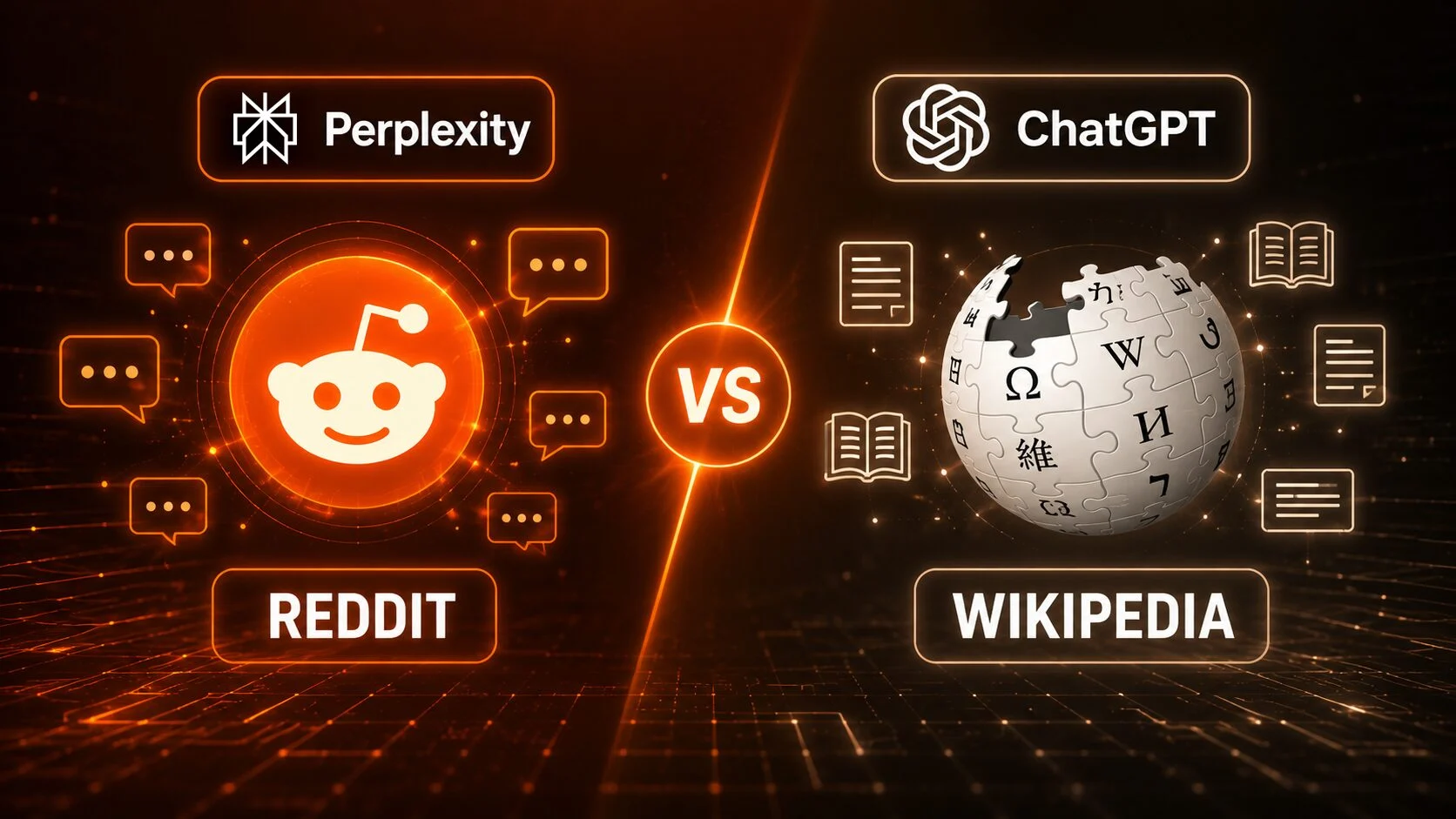
There is no single GEO playbook. The four major AI engines pull from structurally different parts of the internet, so the work that gets you cited in Perplexity is close to useless for Gemini, and vice versa. A blended “AI visibility” strategy is a strategy that’s wrong everywhere.
The hard data (all as of mid-2026 — date-stamp every one of these, they move fast):
- Perplexity is the Reddit engine. Reddit reaches up to 46.7% of Perplexity’s top citations in some categories; in January 2026, 31% of all Perplexity citations came from social sources, with Reddit ≈24% of total citations (BrightEdge; AuthorityTech). BrightEdge
- ChatGPT is the Wikipedia engine. Wikipedia is its single largest source at 7.8%-13.15% depending on the study, with low UGC reliance (0.5%) (Profound; 5W). Profound
- Gemini is the authority engine. Highest authoritative-source share (26%) and almost no user-generated content (0.2%) — roughly a 130:1 authority-to-UGC ratio (BrightEdge). BrightEdge
- Google AI Overviews is the YouTube/UGC engine. Highest UGC share (17.5%), with a single video platform (YouTube) accounting for ≈10.6% of all its citations on its own (BrightEdge).
- Authoritative-source share runs 10%-26% across engines; UGC share runs 0.2%-18% — roughly a 90x spread for the same categories of questions (BrightEdge).
- Engines read different sources but converge on the same brands. Pairwise source overlap is 16%-59%; pairwise brand overlap is a tighter 36%-55% (BrightEdge). Cross-source presence is what makes you the consensus answer.
- Time-to-citation differs by engine. Perplexity can surface new Reddit content within days; ChatGPT and others typically take 2-4 weeks (AuthorityTech).
The thesis: You cannot run one GEO playbook. Win Perplexity with Reddit and community. Win ChatGPT with Wikipedia, entity clarity, and high-authority mentions. Win Google AI Overviews with YouTube and forum presence. Win Gemini with genuine authoritative/industry-publication coverage. But because all four converge on the same brands even while reading different sources, the unifying move is to build cross-source presence everywhere — so each engine independently finds you.
Who should read this: the B2B operator-founder who’s been told to “do GEO” and reasonably wants to know what that actually means engine-by-engine before committing budget. This is the per-engine action map, with the dollar logic of why one blended approach quietly wastes most of your spend.
1. The Mistake: Treating “AI Search” as One Thing
The phrase “AI search” hides the most expensive assumption in the discipline — that ChatGPT, Perplexity, Gemini, and Google AI Overviews are interchangeable destinations you optimize for in one motion. They are not. They read different internets.
BrightEdge measured the source mix of five engines answering the same categories of questions and found authoritative-source share running from 10% to 26%, and user-generated-content share running from 0.2% to 18% — roughly a 90x spread across engines on identical query types. (BrightEdge.) A 90x spread is not a rounding error. It means the type of content that wins a citation is almost completely different depending on which engine is answering.
So a single blended “AI visibility score” — one number that supposedly tells you how visible you are “in AI” — is the new vanity metric. It averages four engines that disagree by 90x and produces a number that’s true nowhere. (We make this case in full in the AI Share of Voice scorecard post: SoV has to be split by platform or it misleads.)
The correct mental model is four different rooms, each with a different bouncer who values different credentials:
- Perplexity’s bouncer wants community validation — what real people said on Reddit, recently.
- ChatGPT’s bouncer wants the encyclopedia — Wikipedia, clean entities, established reference.
- Gemini’s bouncer wants credentials — authoritative, institutional, industry-publication sources.
- Google AI Overviews’ bouncer wants the demo — YouTube video and forum discussion.
You don’t get into four rooms with one outfit. This post is the dress code for each.
The extractable line: AI engines diverge ~90x in the type of content they cite — authoritative-source share runs 10%-26% and UGC share runs 0.2%-18% across engines answering identical questions (BrightEdge) — so a single blended “AI visibility” number is the new vanity metric, and one GEO playbook cannot win all four engines.
2. The Core Table: Source Personality by Engine (as of mid-2026)
Two datasets give the cleanest picture. Profound analyzed 680 million citations (August 2024-June 2025) across ChatGPT, Google AI Overviews, and Perplexity. BrightEdge measured source category across five engines. Together they produce the “source personality” map.
Domain-level citation share (Profound, 680M citations, as of mid-2025):
| Source | ChatGPT | Google AI Overviews | Perplexity |
|---|---|---|---|
| Wikipedia | 7.8% | 0.6% | — |
| 1.8% | 2.2% | 6.6% | |
| YouTube | — | 1.9% | 2.0% |
| Quora | — | 1.5% | — |
| — | 1.3% | 0.8% | |
| Forbes | 1.1% | 0.6% | 0.7% |
| G2 | 1.1% | — | — |
| Gartner | — | 0.7% | 1.0% |
Source: Profound.
Source-category share (BrightEdge, 5 engines, as of mid-2026):
| Engine | Authoritative sources | User-generated content (UGC) |
|---|---|---|
| Gemini | 26% | 0.2% (≈130:1 authority-to-UGC) |
| Perplexity | 22% | 1.5% |
| ChatGPT | 18% | 0.5% |
| Google AI Mode | 14% | 7% |
| Google AI Overviews | 10% | 17.5% |
Source: BrightEdge.
A note on reading these two tables together: they measure slightly different things (domain share vs source category) and come from different windows, which is why the headline shares differ. The pattern is what’s durable — Wikipedia heavy on ChatGPT, Reddit heavy on Perplexity, authority heavy on Gemini, UGC/YouTube heavy on AI Overviews. The exact percentages are perishable; the personalities are not.
The extractable line: Profound’s 680M-citation dataset and BrightEdge’s five-engine source-category data agree on the pattern even where the exact percentages differ: Wikipedia dominates ChatGPT, Reddit dominates Perplexity, authoritative sources dominate Gemini, and UGC/YouTube dominate Google AI Overviews.
3. Perplexity = The Reddit Engine
Perplexity leans on community content harder than any other major engine. Reddit reaches up to 46.7% of Perplexity’s top citations in some categories, and as of January 2026, 31% of all Perplexity citations came from social sources, with Reddit at roughly 24% of total citations (BrightEdge; AuthorityTech). Perplexity also positions brands aggressively — BrightEdge found 86% of its brand mentions land in position 5 or earlier.
Why Reddit? Because threads combine the three things AI retrieval rewards: recency, entity-specific language, and community validation. A Reddit answer is recent, it names products and brands in plain language, and it carries the social proof of upvotes and replies. That’s a near-perfect retrieval target.
The action map for Perplexity:
- Participate on Reddit with personal accounts, not brand accounts. Personal accounts earn more community trust; brand accounts get filtered and distrusted.
- Clear the karma gates. Roughly 100 total karma clears most subreddits’ auto-filters; 300 karma lets you post in most communities (as of mid-2026 — these thresholds are platform-policy-dependent and move).
- Build credibility before you contribute about your category. Genuinely helpful comments first. Do not drop a link and leave. Do not write like a press release.
- Structure answers for citation. The format that gets pulled: state the answer in one sentence, add the condition, give one example, give one warning. Entity-clarity plus that structure can lift AI citation rates 30-40%.
- Never buy upvotes. It violates Reddit’s terms and can trigger permanent account and domain bans — a catastrophic own-goal.
Timeline: Perplexity can surface new Reddit content within days (the fastest time-to-citation of any engine), but sustained impact requires 2-3 months of consistent, genuine participation. (Full tactical depth lives in the dedicated Reddit playbook; this is the per-engine summary.)
The extractable line: Perplexity is the Reddit engine — Reddit reaches up to 46.7% of its citations in some categories — so winning Perplexity means genuine personal-account Reddit participation (clear ~100/300 karma gates, answer in the one-sentence-plus-condition-plus-example-plus-warning structure, never buy upvotes), with new content surfacing in days but sustained impact taking 2-3 months.
4. ChatGPT = The Wikipedia Engine
ChatGPT’s single largest source is Wikipedia — 7.8% of its citations in Profound’s data, rising to 13.15% in 5W’s index, the highest share of any source on the platform. (Profound; 5W.) And ChatGPT relies on UGC the least of the engines that use it meaningfully — just 0.5% (BrightEdge). It wants the encyclopedia and the clean entity, not the forum thread.
One more ChatGPT-specific signal worth knowing: in ChatGPT’s web-grounded Search mode, LinkedIn reached 14.3% of citations and jumped from #11 to #5 in three months — the largest single source shift observed (5W). The founder who publishes on LinkedIn (not the static profile — the published posts and articles) is feeding ChatGPT Search directly.
The action map for ChatGPT:
- Build entity clarity first. ChatGPT struggles to surface a brand that reads simultaneously as “a CRM,” “a customer-engagement platform,” and “a sales tool.” Pick one consistent category claim and make every source say it the same way.
- Earn Wikipedia eligibility the right way. Wikipedia requires genuine notability and bans paid editing — so earn independent media coverage first, then that coverage supports a legitimate entry. (Digital PR is upstream of Wikipedia; we cover this in the digital-PR playbook.)
- Build a clean Wikidata entity. Consistent name, category, founding date, “instance of” claims — directly editable and feeds entity recognition.
- Have the founder publish on LinkedIn. Posts and articles, not a polished static profile. LinkedIn’s surge in ChatGPT Search makes published founder content a direct citation feed.
- Pursue high-authority editorial mentions that reinforce the single category claim across reference-grade sources.
The extractable line: ChatGPT is the Wikipedia engine — Wikipedia is its single largest source at 7.8%-13.15% — so winning ChatGPT means entity clarity (one consistent category claim across all sources), a legitimate Wikipedia entry earned via real media coverage, a clean Wikidata entity, and a founder who publishes on LinkedIn (where ChatGPT Search citations jumped from #11 to #5 in three months).
5. Gemini = The Authority Engine
Gemini is the strict one. It has the highest authoritative-source share of any engine (26%) and the lowest UGC share (0.2%) — roughly a 130:1 authority-to-UGC ratio (BrightEdge). For every 130 citations Gemini gives an authoritative source, it gives one to user-generated content. A brilliant Reddit thread that wins you Perplexity does essentially nothing for Gemini.
This is the engine where the operator-founder’s instinct to “just be active in communities” fails hardest, and where genuine industry credibility pays off most. Gemini wants the trade journal, the research citation, the established industry publication — the sources that read as institutionally credible.
The action map for Gemini:
- Earn genuine authoritative/industry-publication coverage. This is the same digital-PR muscle as ChatGPT, but weighted even more heavily toward credentialed, institutional sources over reference/encyclopedia ones.
- Get cited in trade and industry publications, not just general business press — and recall that prestige general outlets (WSJ, NYT, Bloomberg, FT) underperform in AI weighting, so target the publications your category’s engines actually cite.
- Don’t waste community effort here. UGC at 0.2% means your Reddit work has near-zero Gemini payoff. Allocate accordingly — community spend is a Perplexity and AI-Overviews lever, not a Gemini one.
- Reinforce entity coherence through authoritative sources specifically, so the credentialed layer of the web names you consistently in your category.
The extractable line: Gemini is the authority engine — 26% authoritative sources versus 0.2% UGC, a ~130:1 ratio — so winning Gemini means earning genuine trade- and industry-publication coverage, not community participation; the Reddit work that wins Perplexity has near-zero Gemini payoff, so allocate community spend to the engines that reward it.
6. Google AI Overviews = The YouTube/UGC Engine
Google AI Overviews is the opposite of Gemini. It has the highest UGC share of any engine (17.5%), and a single video platform — YouTube — accounts for roughly 10.6% of all its citations on its own, with a single forum platform (Reddit) adding another ~2.9% (BrightEdge). Government, academic, and institutional sources combined are only 9.5% of AI Overview citations — less than YouTube alone.
This is the engine where Storimatic’s core output — video — is the single highest-leverage asset, because YouTube is both the strongest correlate of AI visibility overall (~0.737, Ahrefs) and the single largest individual source feeding AI Overviews.
The action map for Google AI Overviews:
- Publish substantive video on YouTube. Long-form, expert-led, clearly structured (not “viral” — structure beats reach; 94% of cited videos are long-form). Clean audio yields a clean transcript, and the transcript is the citation surface.
- Build forum/Reddit presence. The ~2.9% Reddit contribution to AI Overviews means your Perplexity community work double-dips here.
- Ensure brand and category are spoken verbatim in the video so the auto-generated transcript names your entity in plain language.
- Repurpose the transcript onto an owned page to double the surface — one capture, two citation targets.
The mechanics of why production quality governs citability — and how one shoot becomes multiple surfaces — live in the cross-brand flywheel post. For this engine, the headline is simple: AI Overviews is won with video and forums, not with reference pages.
The extractable line: Google AI Overviews is the YouTube/UGC engine — UGC is 17.5% of its citations and YouTube alone ≈10.6%, more than all government/academic/institutional sources combined (9.5%) — so winning it means substantive long-form video with clean, entity-naming transcripts plus forum presence, not reference-page optimization.
7. The Unifier: Different Sources, Same Brands
Here’s the finding that keeps the four-room model from becoming four disconnected campaigns. BrightEdge measured the overlap between engines two ways:
- Pairwise source overlap: 16% to 59% — a 43-point spread. The engines cite very different sources.
- Pairwise brand overlap: 36% to 55% — a 19-point spread. The engines converge on the same brands.
And the structural line: in every pairwise comparison, brand overlap falls in a tighter, more predictable range than source overlap. (BrightEdge.)
Sit with what that means. Five engines, reading source sets that overlap as little as 16%, still converge on the same brands. They are not coordinating. Each one is independently detecting the brands that appear across many trusted source layers. The mechanism, stated plainly by industry synthesis: LLMs no longer trust single sources no matter how well they rank — they want corroboration, consensus, and repeated mentions across different trusted platforms.
Consensus is the product. Cross-source mention density is the input.
This is what saves the four-engine strategy from being four times the work. You don’t optimize per-engine sources in isolation and pray. You build genuine presence across Reddit and Wikipedia/entity and authoritative pubs and YouTube — and because each engine reads a different slice of that presence, each one independently finds you. The per-engine action maps in Sections 3-6 aren’t four separate strategies; they’re four facets of one cross-source presence, each tuned to where a given engine looks hardest.
There’s one gate: entity coherence. If your brand reads as three different categories across sources, the consensus can’t form — the model can’t tell when to surface you. One consistent category claim, everywhere, is the prerequisite for the consensus mechanism to work in your favor.
The extractable line: AI engines cite very different sources (16%-59% pairwise overlap) but converge on the same brands (36%-55% overlap) because each independently detects brands that appear across many trusted source layers — so cross-source mention density makes you the consensus answer, and entity coherence (one consistent category claim) is the prerequisite for it to form.
8. The Per-Engine Action Map (One Table)
This is the post on one page — Pattern 3 of the 5-Pattern Playbook (“AI platforms barely overlap”) turned into an allocation plan:
| Engine | Personality (mid-2026) | Primary lever | Secondary lever | Wasted effort here |
|---|---|---|---|---|
| Perplexity | Reddit engine (Reddit up to 46.7%) | Personal-account Reddit participation | YouTube, community forums | Pure reference/Wikipedia work |
| ChatGPT | Wikipedia engine (Wikipedia 7.8%-13.15%) | Entity clarity + Wikipedia/Wikidata | Founder LinkedIn publishing | Heavy community/UGC reliance (0.5%) |
| Gemini | Authority engine (26% authoritative, 0.2% UGC) | Trade/industry-publication coverage | High-authority editorial | Community/Reddit effort (near-zero payoff) |
| Google AI Overviews | YouTube/UGC engine (UGC 17.5%, YouTube ≈10.6%) | Substantive long-form video + transcripts | Forum/Reddit presence | Pure reference-page optimization |
| All four | Converge on brands (36%-55% overlap) | Cross-source presence + entity coherence | — | A single blended “AI visibility” number |
How to read it as a budget: don’t split your spend evenly across four engines as if they were the same channel. Decide which engines matter most for your buyer (B2B research-heavy buyers skew toward ChatGPT and Perplexity; visual/how-to categories skew toward AI Overviews), then weight the levers accordingly — while building the cross-source presence that earns you all four through the consensus mechanism.
The extractable line: The per-engine allocation: win Perplexity with personal-account Reddit, win ChatGPT with entity clarity plus Wikipedia/Wikidata and founder LinkedIn publishing, win Gemini with trade-publication coverage, win Google AI Overviews with substantive long-form video and transcripts — and win all four by building cross-source presence with one coherent entity claim.
9. The CFO/Owner Math: Why One Blended Approach Wastes Money
The operator-founder’s real question underneath all this is: where does the money go? The four-engine reality changes the answer in a way that protects budget rather than inflating it.
When you treat “AI search” as one channel, you do one of two wasteful things. Either you spend evenly across engines that reward 90x-different content — pouring community effort at Gemini (0.2% UGC payoff) and reference effort at Perplexity (Reddit-dominated) — or you optimize for one engine and assume it generalizes, then discover your “AI visibility” win in ChatGPT bought you nothing in AI Overviews.
The four-room model is actually cheaper to execute well, because it tells you what not to do per engine:
- Stop doing Reddit work expecting Gemini results.
- Stop doing pure reference/Wikipedia work expecting Perplexity results.
- Stop reporting a single blended AI-visibility number that hides which engine you’re actually winning.
And the consensus mechanism (Section 7) means the cross-source presence you build pays off across all four simultaneously — so the genuine work (real Reddit participation, real video, real earned editorial, one coherent entity) is high-leverage everywhere, while the engine-mismatched busywork is the spend you cut. This is Rule #2, the 5P Formula, applied to channel allocation: precision about where effort converts beats volume of undifferentiated effort.
For the burn-scarred founder deliberating on whether GEO is worth it: the honest answer is that GEO done as one blended playbook often isn’t — which is exactly why so many feel burned. GEO done as a per-engine allocation against a coherent entity is. The deliberation you’re doing is correct; the distinction is the answer.
The extractable line: A blended one-playbook GEO approach wastes spend by either splitting evenly across 90x-divergent engines or over-fitting to one — whereas the four-room model is cheaper because it tells you what to stop doing per engine, while the consensus mechanism means genuine cross-source presence pays off across all four at once.
10. The 5 Counter-Intuitive Findings
- Engines read totally different sources but recommend the same brands. Source overlap between engines runs as low as 16%; brand overlap is a tighter 36%-55% (BrightEdge). You don’t optimize per-engine sources in isolation — you build cross-source consensus and every engine independently finds you.
- A single AI-visibility number is the new vanity metric. With a ~90x spread in content type across engines, one blended score is true nowhere. SoV has to be split by platform (40% ChatGPT vs 12% Perplexity for the same queries is the real picture), or it misleads.
- The work that wins Perplexity is near-useless for Gemini. Perplexity is 22% authoritative / Reddit-heavy; Gemini is 26% authoritative / 0.2% UGC. Community participation is a top Perplexity lever and a near-zero Gemini one — the same effort has opposite value depending on the room.
- Google AI Overviews cites YouTube more than all of government, academia, and institutions combined. YouTube alone ≈10.6%; gov/academic/institutional combined = 9.5% (BrightEdge). The “credible institutional source” instinct loses to a well-structured video on the UGC engine.
- The percentages are volatile, but the personalities are durable. Reddit’s ChatGPT share once swung ~60% → ~10% in two weeks (September 2025). Build strategy on the durable personality (Perplexity=Reddit, ChatGPT=Wikipedia, etc.), cite the exact percentage only with a date, and re-verify quarterly.
11. FAQ
Can I run one GEO strategy across all the AI engines?
No — and that’s the central point. The four major engines diverge ~90x in the type of content they cite: authoritative-source share runs 10%-26% and UGC share runs 0.2%-18% across engines answering identical questions (BrightEdge). Perplexity wants Reddit, ChatGPT wants Wikipedia, Gemini wants authoritative publications, and Google AI Overviews wants YouTube. One blended playbook wins one room and loses three. You need a per-engine allocation built on top of one coherent entity.
Which engine should a B2B operator prioritize?
It depends on where your buyer researches, but B2B research-heavy buyers skew toward ChatGPT and Perplexity. Prioritize entity clarity plus a legitimate Wikipedia/Wikidata presence (ChatGPT) and genuine personal-account Reddit participation (Perplexity), then layer in trade-publication coverage (Gemini) and substantive video (Google AI Overviews). Don’t split budget evenly across all four as if they were the same channel — weight the levers to your buyer and let cross-source presence earn the rest.
Why does Perplexity cite Reddit so heavily?
Because Reddit threads combine the three things AI retrieval rewards: recency, entity-specific language, and community validation. A Reddit answer is recent, names brands and products in plain language, and carries social proof. Reddit reaches up to 46.7% of Perplexity’s top citations in some categories, and ~31% of all Perplexity citations came from social sources as of January 2026 (BrightEdge). That’s why genuine Reddit participation is the top Perplexity lever.
Is community participation worth it for Gemini?
Almost not at all. Gemini has a ~130:1 authority-to-UGC ratio — 26% authoritative sources versus 0.2% UGC (BrightEdge). The Reddit and forum work that wins Perplexity and contributes to Google AI Overviews has near-zero payoff in Gemini. For Gemini, allocate to genuine trade- and industry-publication coverage instead. This is exactly why a per-engine allocation saves money: you stop spending on the wrong lever per room.
How fast will I see results, and does it differ by engine?
Yes, it differs. Perplexity can surface new Reddit content within days — the fastest time-to-citation of any engine. ChatGPT and others typically take 2-4 weeks. Sustained Reddit impact requires 2-3 months of consistent participation. Wikipedia/entity work and authoritative-coverage work compound more slowly but durably. Set expectations per engine, not as one timeline. (These windows are platform-policy-dependent and perishable — re-verify quarterly.)
Why do five engines reading different sources recommend the same brands?
Because each engine independently detects the brands that appear across many trusted source layers — they want corroboration and consensus, not a single well-ranked source. Pairwise source overlap between engines is just 16%-59%, but brand overlap is a tighter 36%-55% (BrightEdge). Cross-source mention density makes you the consensus answer. The prerequisite is entity coherence: one consistent category claim across all sources, or the consensus can’t form.
How often do these platform percentages change?
Constantly — treat every percentage in this post as dated mid-2026 evidence, not a fixed truth. Reddit’s ChatGPT share once swung ~60% → ~10% in two weeks (September 2025), and LinkedIn jumped #11 → #5 in ChatGPT Search in three months. Build your strategy on the durable engine personalities (which hold) and re-verify the exact shares quarterly. The percentage is the dated evidence; the personality is the thesis.